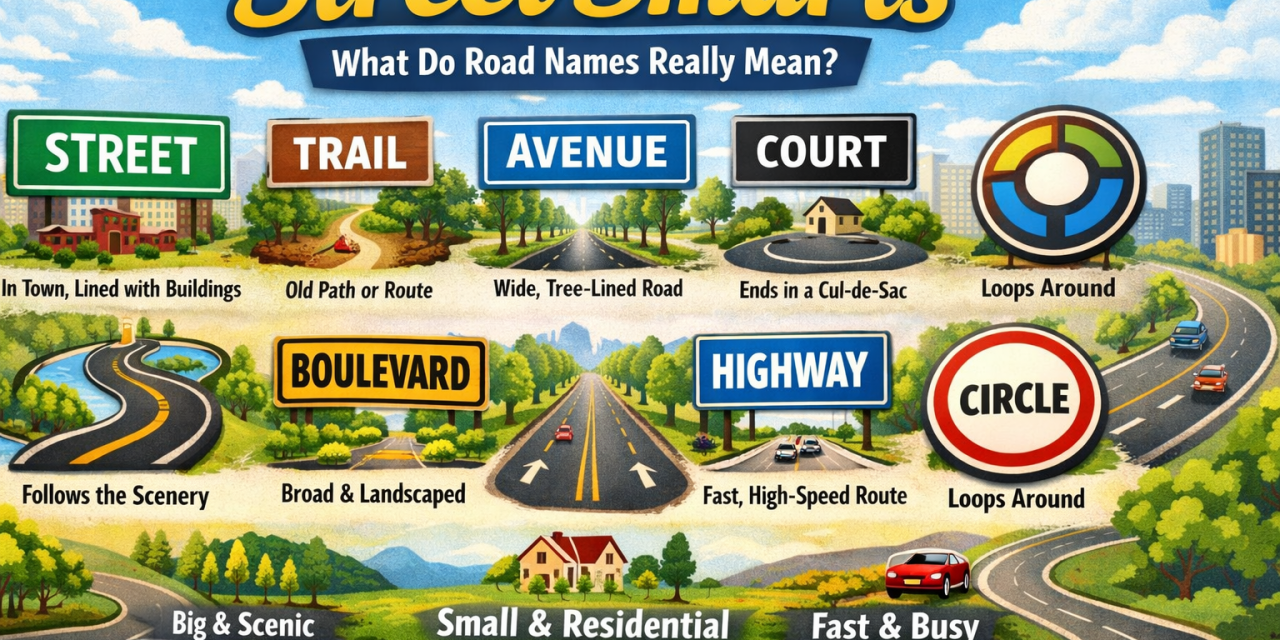
Ever notice how every road has a different title? Street. Road. Avenue. Boulevard. Drive. Court. It’s like roads went to college and picked different majors. While cities don’t always follow the rules perfectly, most of these names started with very specific meanings. They’re little clues about how a road was designed, how it moves traffic, or what kind of place it was meant to serve.
Think of street names as the job titles of the road world.
Street
The classic.
A street usually runs through a town or city and is lined with buildings. It’s where people live, shop, and walk around.
If roads had personalities, streets would be social. They like foot traffic, storefronts, and stoplights.
Road
The generalist.
A road connects places. Town to town. Area to area. It doesn’t promise anything fancy.
Road is the word you use when you don’t want to commit to a personality.
Avenue
The organizer.
Traditionally, avenues run perpendicular to streets and are often wider. Many were designed to be scenic and lined with trees.
Avenues are the “structured” ones. They like order and sometimes wear landscaping.
Boulevard
The show-off.
A boulevard is wide, multi-lane, and often landscaped with medians or trees.
Boulevards were built to be impressive. They’re the roads that put on a suit before leaving the house.
Drive
The scenic route.
A drive usually follows the natural shape of the land—curves, hills, lakes, or rivers.
Drives don’t rush. They enjoy the view.
Lane
The quiet one.
A lane is smaller, narrower, and often residential.
If streets are social, lanes are introverts.
Court
The dead-end specialist.
A court usually ends in a cul-de-sac or a small circular area.
Courts are cozy. They like limited traffic and knowing all their neighbors.
Way
The flexible helper.
A way is usually a small side street or connector.
It exists to get you from here to there without making a big deal about it.
Place
The finisher.
A place often ends in a cul-de-sac or short loop, similar to a court.
Short, quiet, and intentional.
Terrace
The elevated one.
A terrace traditionally followed a ridge or higher ground.
It literally looked down on other roads.
Parkway
The green traveler.
A parkway was designed to be a scenic route through parks or green space.
Originally: no trucks, no chaos, just smooth cruising.
Expressway / Freeway / Highway
The speed demons.
These are built for fast travel and long distances, with limited stops and access points.
They don’t care about charm. They care about velocity.
Circle
The spinner.
A circle loops back onto itself or surrounds a central feature.
Great for confusing delivery drivers.
Trail
The historical one.
A trail often follows an old path, trade route, or natural travel corridor.
It existed before your GPS.
Loop
The returner.
A loop reconnects with itself or the main road.
You’ll end up where you started, just slightly wiser.
So Do Cities Always Follow These Rules?
Not even close.
Modern naming is often driven by:
- Tradition
- Marketing appeal
- Subdivision themes
- Whatever sounded nice that day
That’s how you end up with tiny residential roads called “Boulevard” and winding dirt paths named “Avenue.”
The rules are historical, not enforced law.
Why It Still Matters
Even loosely followed, street names give hints:
- Traffic type
- Road size
- Residential vs. commercial
- Scenic vs. functional
They’re small signals that help you understand how a place was designed to move people.
Final Thought
Street names aren’t random. They’re leftover fingerprints of city planning, transportation history, and human creativity.
Every time you read a street sign, you’re seeing a tiny piece of design philosophy—whether the city followed it or not.